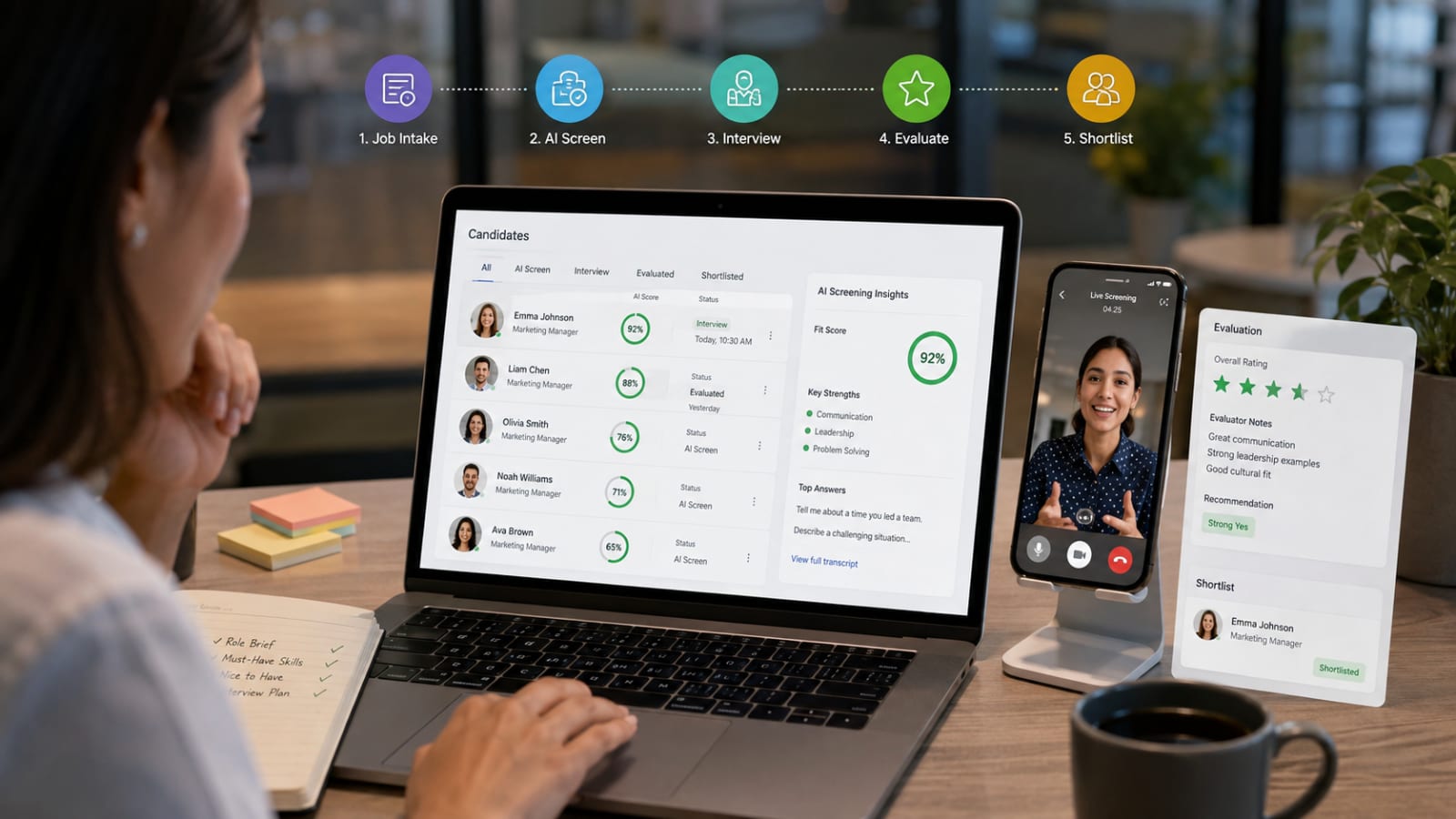
First-round screening is the most repetitive work in recruitment: the same five questions, asked politely, hundreds of times — notice period, current CTC, expected CTC, location, willingness to relocate. It is also the easiest stage to automate well, because the goal is structured information, not judgement. Here is how teams actually do it with an AI voice agent.
Step 1 — Write the agent’s script as instructions, not lines
You do not write a word-for-word script. You write a system prompt: who the agent is, what it must learn, and how to behave. A real example:
“You are a friendly recruiter for Acme’s Java Developer role. Confirm the candidate applied. Learn: total experience, current and expected CTC, notice period, and whether they can work from Hyderabad. If they ask about the role, answer from the job description. Keep the call under four minutes and thank them for their time.”
The agent handles the conversation from there — including interruptions, clarifying questions and candidates who answer three things in one sentence.
Step 2 — Upload your candidate list
A CSV with names and phone numbers is enough. Extra columns (role applied for, source, city) become variables the agent can use mid-call — “I’m calling about your application for the Java Developer role” lands much better than a generic opening.
Step 3 — Set the calling window and launch
Serious platforms let you set business-hours windows (say 10am–7pm IST), retry rules for no-answers and busy lines, and how many calls run in parallel. A campaign of 300 candidates at 5 concurrent calls finishes in an afternoon — with no recruiter on the phone.
Step 4 — Define what “good” looks like, and let the AI rate every call
This is the step teams underuse. Instead of reading 300 transcripts, define rating criteria — communication, relevant experience, notice-period fit — and the platform scores every finished call against them. In Veytrix, every call automatically gets a transcript, a summary, extracted fields and a per-skill rating; the Ratings page then gives you a ranked shortlist you can export to Google Sheets.
Step 5 — Humans take over exactly where they add value
The output of automated screening is not a hire — it is a clean shortlist. Recruiters spend their time on the top 40 conversations instead of the full 300 dials, and candidates get a response in hours instead of days. Teams typically report 60–80% less time spent on first-round screening within the first month.
Common questions
Do candidates hang up on AI? Fewer than you would expect — when the agent is upfront, polite, calls from a local +91 number and actually answers questions about the role. Completion rates track how good your prompt and calling window are.
What about Hindi/Telugu/Tamil speakers? Use a platform with Indian-language speech recognition. Veytrix runs Sarvam AI for exactly this; the agent can hold the conversation in the candidate’s language.
What does it cost per candidate? A typical 3-minute screening call at ₹5/min is about ₹15 — less than the cost of the coffee during a manual phone screen. Plans and per-minute rates are on our pricing page.
Want to see it on your own JD?Create a free workspace, paste your job description into an agent, and test-call your own phone — the whole loop takes about ten minutes. The documentation walks through every step.