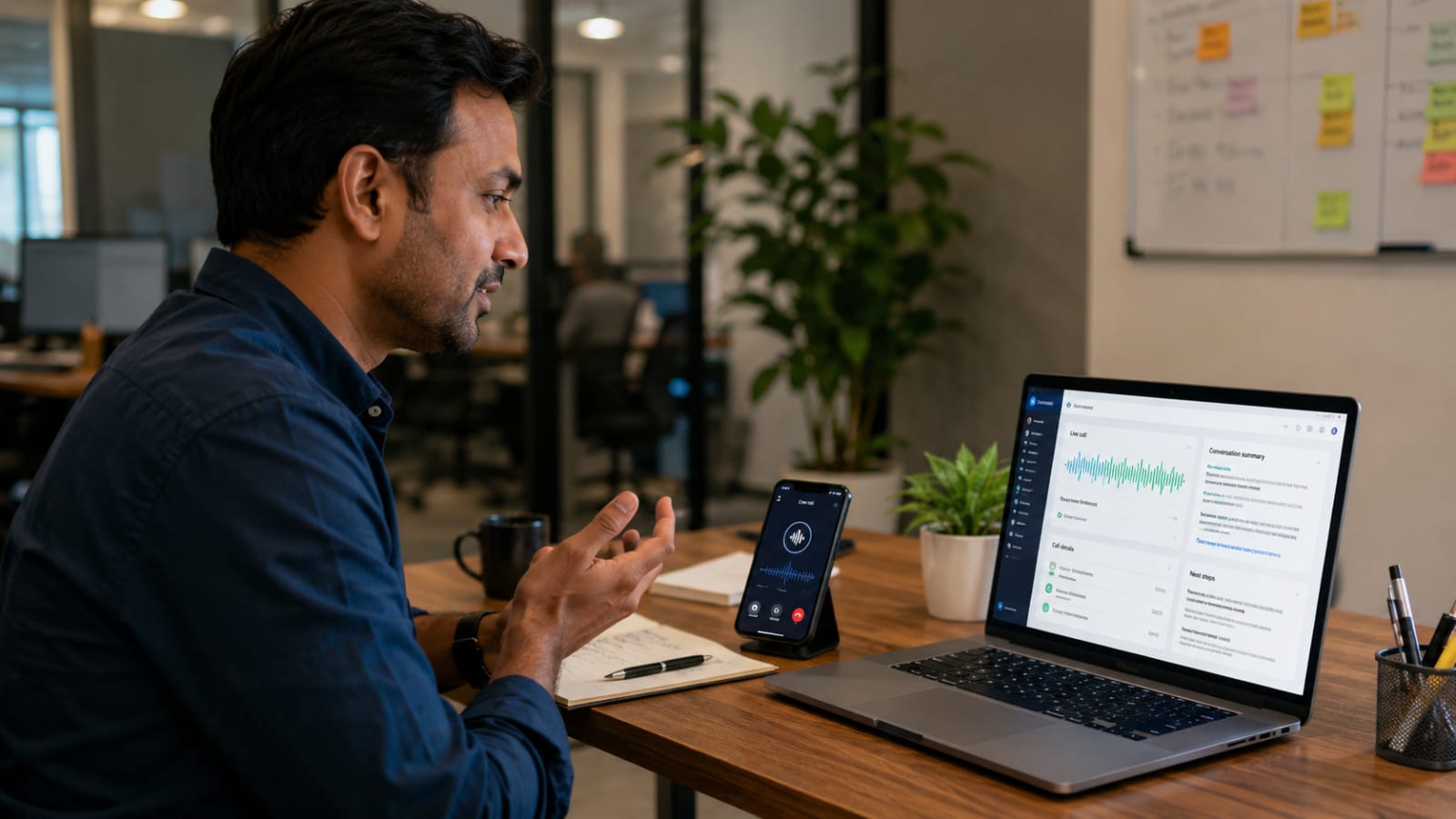
If your team spends hours every day dialing candidates, leads, or customers and having roughly the same conversation each time, you have a process an AI calling agent can run for you. Not an IVR menu, not a robocall — a system that speaks naturally, listens to free-form answers, asks follow-up questions, and writes down everything it learned the moment the call ends.
AI calling agent vs. IVR: they are not the same thing
Most Indian businesses have used an IVR: “Press 1 for sales, press 2 for support.” An IVR plays recordings and accepts keypad input. An AI calling agent is a different category of software. It combines four technologies into one live phone call:
- Telephony — places or answers the actual call on a real phone number (Veytrix uses Plivo with Indian +91 numbers).
- Speech-to-text — transcribes what the person says in real time, including Indian languages and accents (we use Sarvam AI for exactly this reason).
- A large language model — decides what to say next based on your instructions and what the person actually said (Google Gemini in our stack).
- Text-to-speech — speaks the reply back in a natural voice within a couple of seconds (Cartesia, tuned for low latency).
The result: the person on the phone can interrupt, go off-script, ask a question, or answer in their own words — and the agent keeps up, the way a human caller would.
What happens after the call is where the real value is
A human telecaller finishes a call and writes two lines in a spreadsheet — if you are lucky. An AI calling agent produces, automatically and for every single call:
- A full speaker-separated transcript
- A summary of what was discussed
- Structured data extracted from the conversation (notice period, expected salary, interest level — whatever you define)
- An AI rating scored against your own criteria
That means a recruiter screening 300 candidates gets a ranked, searchable list by morning — instead of a week of dialing.
Where Indian teams use AI calling agents today
- Recruitment — first-round screening calls at scale, in English, Hindi, Telugu or Tamil
- Sales — lead qualification before a human rep spends time on the call
- EdTech — admission follow-ups, placement-intent confirmation
- Operations — appointment reminders, payment reminders, NPS and feedback surveys
- Announcements — one-way voice broadcasts at a lower per-minute rate
What does it cost?
Per-minute pricing is the industry norm. Veytrix bills two-way conversation calls from ₹4–5 per call-minute depending on plan (one-way announcements at ₹1.5/min), with telephony, speech recognition, the language model and the voice all included — see the pricing section for current plans. Compare that with the fully loaded cost of a telecaller who makes 60–80 calls a day, and the math usually settles the question for high-volume, repetitive calling.
How to evaluate one (a 15-minute test)
- Give the agent your real script or job description — not a demo script.
- Have it call your own phone. Interrupt it mid-sentence. Answer vaguely. Switch to Hindi.
- Read the transcript and rating it produces. That output IS the product.
You can run exactly that test on Veytrix in minutes: create a workspace, build an agent with your prompt, and place a test call to your own number. Or start even simpler — enter your number in the “Call me” box on our home page and talk to our demo agent right now.